
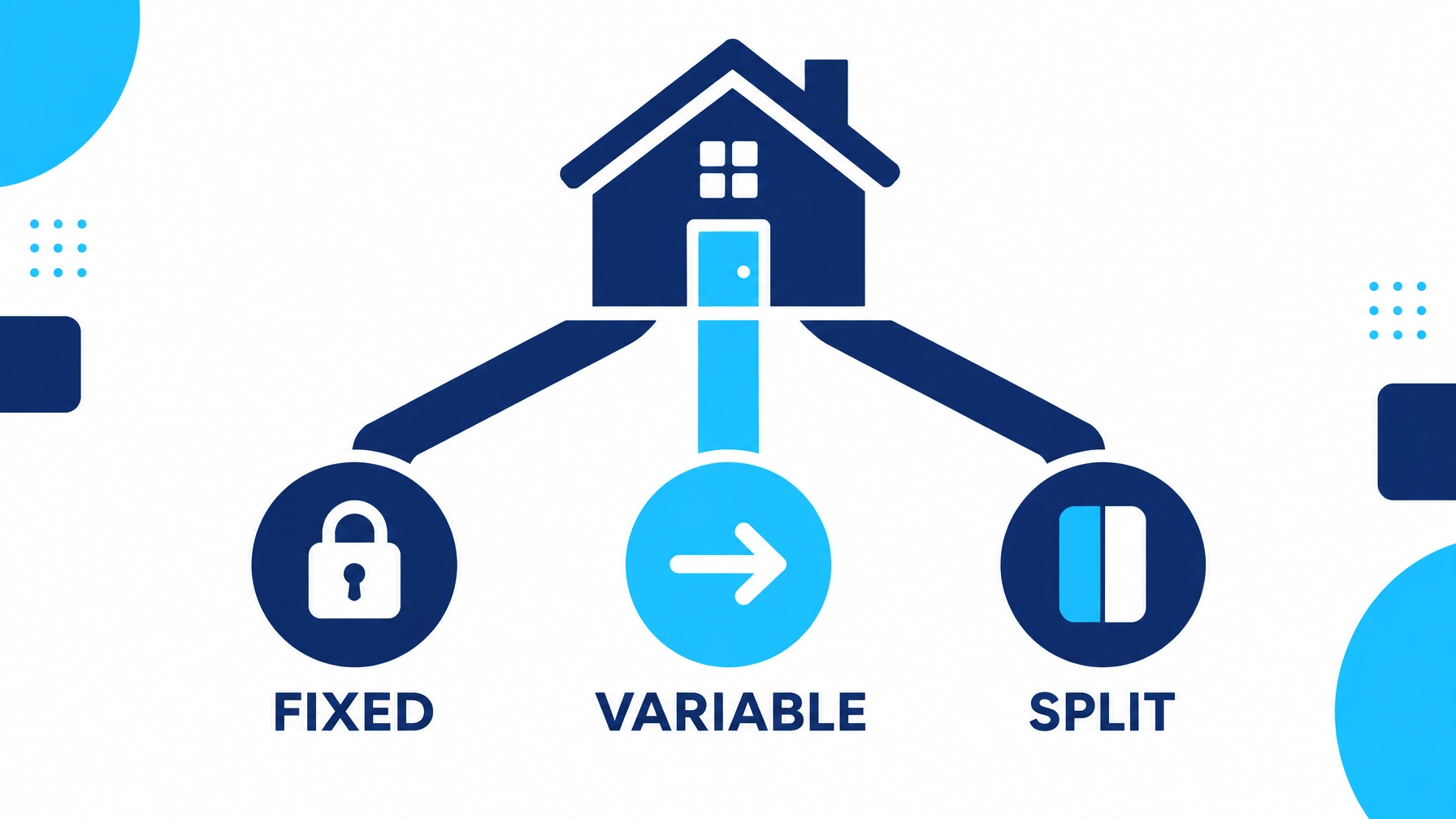
When interest rates are moving, choosing a home loan is not simply about finding the lowest advertised number. The structure you select determines how much certainty you have, how easily you can make extra repayments, whether you can use an offset account, and how expensive it may be to change direction later.
A fixed loan can make repayments easier to budget. A variable loan can provide valuable flexibility. A split loan can combine both, but only if the proportions are designed around your cash flow and future plans.
The key is to choose a structure that supports your broader home loan payoff strategies, rather than treating the interest rate as the only decision.
Fixed, variable and split loans: what is the difference?
Fixed-rate home loan
A fixed-rate loan locks your interest rate for an agreed period, commonly one to five years.
Potential advantages include:
- More predictable repayments during the fixed term
- Protection if variable rates rise
- Easier household budgeting
- Greater certainty for borrowers with limited monthly surplus
However, fixed loans generally restrict your ability to change the loan or pay it down aggressively. Extra repayments may be capped, and an offset account is often unavailable on the fixed portion.
Variable-rate home loan
A variable rate can move up or down as market conditions and lender pricing change.
Variable loans commonly offer:
- Greater repayment flexibility
- Unlimited or higher extra-repayment allowances
- Redraw access, subject to lender rules
- Eligibility for a mortgage offset account
- No fixed-rate break cost if you repay or refinance, although ordinary discharge or switching fees may still apply
The trade-off is that your repayments can rise. You need enough cash-flow capacity to manage rate increases without abandoning your long-term repayment plan.
Split home loan
A split loan divides your borrowing into separate portions. For example:
- $360,000 fixed
- $240,000 variable
The fixed portion provides repayment certainty, while the variable portion preserves flexibility for an offset account and additional repayments.
A split is not automatically the “middle ground” solution. The ratio matters, and an unsuitable split can leave you with too little flexibility or too much exposure to rising rates.

The decision should start with your priorities
Before comparing rates, assess how you expect to use the loan over the next three to five years.
Ask yourself:
-
How important is repayment certainty?
Would a higher repayment create genuine financial stress, or would it simply require some budget adjustments? -
How much surplus cash do you regularly have?
Consider salary credits, bonuses, savings and planned extra repayments. -
Are you likely to sell, refinance or change your loan?
A fixed term can become expensive if your circumstances change. -
Do you need an offset account?
If you hold substantial savings or run most household cash flow through one account, the mortgage offset account benefits may be significant. -
How stable is your income?
A borrower with predictable income and limited financial changes may value certainty more than flexibility. -
Is paying off the loan early a priority?
If your goal is to pay off your home loan early, the loan must allow your repayment strategy to operate efficiently.
When fixing your loan can make sense
Fixing may be appropriate when certainty has a clear practical value.
You may consider fixing part or all of the loan if:
- Your household budget cannot comfortably absorb higher repayments
- You prefer a known repayment amount for the next few years
- You have limited savings available for an offset
- You are not planning to sell or refinance during the fixed period
- Your expected extra repayments are comfortably below the lender’s fixed-loan limit
- You are willing to accept that rates may later fall
Supporters of fixed rates value stability. Critics point out that fixing requires accepting today’s rate and surrendering some flexibility. Both perspectives are valid. The right answer depends on how much certainty is worth to your household.
When fixing can become a trap
A fixed loan may work against you when:
- You expect to receive a large inheritance, bonus or business payment
- You may sell the property before the fixed term ends
- You expect to refinance soon
- You want to maintain a large offset balance
- You regularly make significant extra repayments
- Your family circumstances may change
- You are fixing mainly because you are trying to predict the next rate movement
In reality, rate forecasts are uncertain. A fixed rate is best assessed as a risk-management decision, not as a bet that rates will move in one particular direction.
How to size a split loan without guessing
There is no universal “best” split ratio. A more useful approach is to size each portion according to how you plan to use it.
Step 1: Calculate your flexible cash-flow requirement
Estimate the money you may direct towards:
- Your offset account
- Regular extra repayments
- Annual bonuses
- Tax refunds
- Irregular income
- Planned renovations or large expenses
Your variable portion should be large enough to accommodate this activity. If you expect to keep $50,000 in savings and make $1,000 per month in additional repayments, a very small variable portion may be unsuitable.
Step 2: Set your certainty target
Next, determine how much of the loan you want protected from rate movements.
For example:
- A borrower prioritising certainty may consider a larger fixed portion.
- A borrower with strong cash flow and significant savings may prefer a larger variable portion.
- A borrower who wants a balance may begin modelling a 50/50 or 60/40 split.
These are starting points, not recommendations. Product rules, rates, fees and your financial circumstances must be assessed together.
Step 3: Stress-test the variable portion
Do not assess the variable repayment at today’s rate only. Model what would happen if the variable rate increased by 1% or 2%.
If the result would force you to stop your planned repayments or use credit cards to cover expenses, the variable portion may be too large.
Worked example: a $600,000 loan
Assume the following illustrative rates:
- Total loan: $600,000
- Term: 25 years
- Fixed rate: 5.90%
- Variable rate: 6.20%
- Split: $360,000 fixed and $240,000 variable
Approximate principal-and-interest repayments would be:
- Entirely fixed: about $3,833 per month
- Entirely variable: about $3,932 per month
- 60/40 split: about $3,872 per month
Now assume the variable portion has a $50,000 offset balance.
The $50,000 offset would reduce the balance used to calculate interest on the variable portion from $240,000 to approximately $190,000. At a variable rate of 6.20%, that represents an initial interest reduction of roughly:
$50,000 × 6.20% = $3,100 per year
This is a simplified illustration before fees, rate changes and balance movements. The saving only applies to the eligible variable portion, not the fixed portion.
The practical lesson is important: the variable split must be large enough to hold your offset balance. Otherwise, some of your cash may not be working as efficiently as it could.
Break costs: the fine print that can change the decision
A break cost is an amount charged when you terminate or materially change a fixed-rate contract before the fixed term ends.
It may apply if you:
- Sell the property
- Refinance with another lender
- Switch from fixed to variable
- Repay the fixed portion early
- Exceed the allowed extra-repayment limit
- Change the loan structure during the fixed period
Break costs are generally influenced by:
- The fixed portion’s outstanding balance
- The time remaining
- The difference between relevant wholesale rates when you fixed and when you exit
A simplified example:
- Fixed balance: $400,000
- Time remaining: two years
- Relevant rate movement: 0.50%
$400,000 × 2 × 0.50% = approximately $4,000
This is not a lender quote or an exact calculation. Actual formulas vary and may include discounting, administration charges and other adjustments. The longer the remaining term and the larger the fixed balance, the greater the potential exposure can be.

Before fixing, check:
- The permitted extra repayments
- Whether the limit is annual or applies across the entire fixed term
- Whether redraw is available
- Whether an offset account is available
- The cost of switching or discharging
- The rate that applies when the fixed period ends
- Whether the loan is portable if you move home
- How a split can be changed later
If you are already fixed and considering refinancing, request a written break-cost quote from the lender before comparing potential savings.
How structure supports paying off your home loan sooner
The structure itself does not magically reduce your mortgage term. Its value is that it determines whether your money can be directed efficiently towards the debt.
A well-designed structure can help you:
- Keep surplus cash against an eligible variable balance
- Make extra repayments without exceeding fixed-loan limits
- Preserve access to cash for emergencies
- Avoid unnecessary break costs
- Maintain a repayment level above the required minimum
- Review and adjust the loan at the end of a fixed term
For example, if a $600,000 loan at a constant illustrative rate of 6.20% is repaid at approximately $3,932 per month, the scheduled term is about 25 years. If the borrower consistently pays an additional $500 per month, the loan could be reduced in roughly 19 years instead, potentially saving several years and more than $100,000 in interest under those simplified assumptions.
Actual results will vary as rates, balances and household circumstances change. The structure’s job is to make the repayment plan workable and sustainable.
For more detail on using cash flow effectively, read our guides on mortgage offset account benefits and strategic extra repayments.
A practical decision framework
Use this checklist before selecting a structure.
Consider a mostly variable loan if:
- You need flexibility
- You maintain meaningful savings
- You want an offset account
- You expect to make substantial extra repayments
- You may refinance or sell
- You can manage repayment increases
Consider a mostly fixed loan if:
- Repayment certainty is your highest priority
- Your income and plans are stable
- You have limited use for an offset
- You do not expect to make large extra repayments
- You are comfortable remaining in the loan for the fixed period
Consider a split loan if:
- You want some protection from rising rates
- You also need an offset or flexible repayment facility
- You can estimate your likely cash-flow needs
- You want to reduce the amount exposed to fixed-loan break costs
- You are comfortable reviewing the structure when the fixed term ends
The right structure is personal
There is no universally superior choice between fixed, variable and split loans. The lowest rate may not produce the lowest overall cost if it prevents you from using your savings, making repayments or adapting to changes.
A smart home loan aligns the rate type, loan features, repayment strategy and likely future events. That is why a detailed review can be more useful than choosing from a rate table alone.
Flexible Mortgages can help you assess the options through a no-obligation Smart Home Loan discovery discussion. The conversation can focus on your current loan, cash flow, offset needs, refinancing plans and practical ways to reduce mortgage interest over time.
Information in this article is general in nature and does not take into account your objectives, financial situation or needs. It is not personal financial advice. Loan features, rates, fees, repayment limits and break-cost calculations vary between lenders and products. Consider the relevant loan contract and product documents, and obtain professional advice before making a borrowing or refinancing decision.
With the right structure and a disciplined plan, paying off your home loan early can become easier than many people expect: supporting greater security, financial freedom and long-term success.