
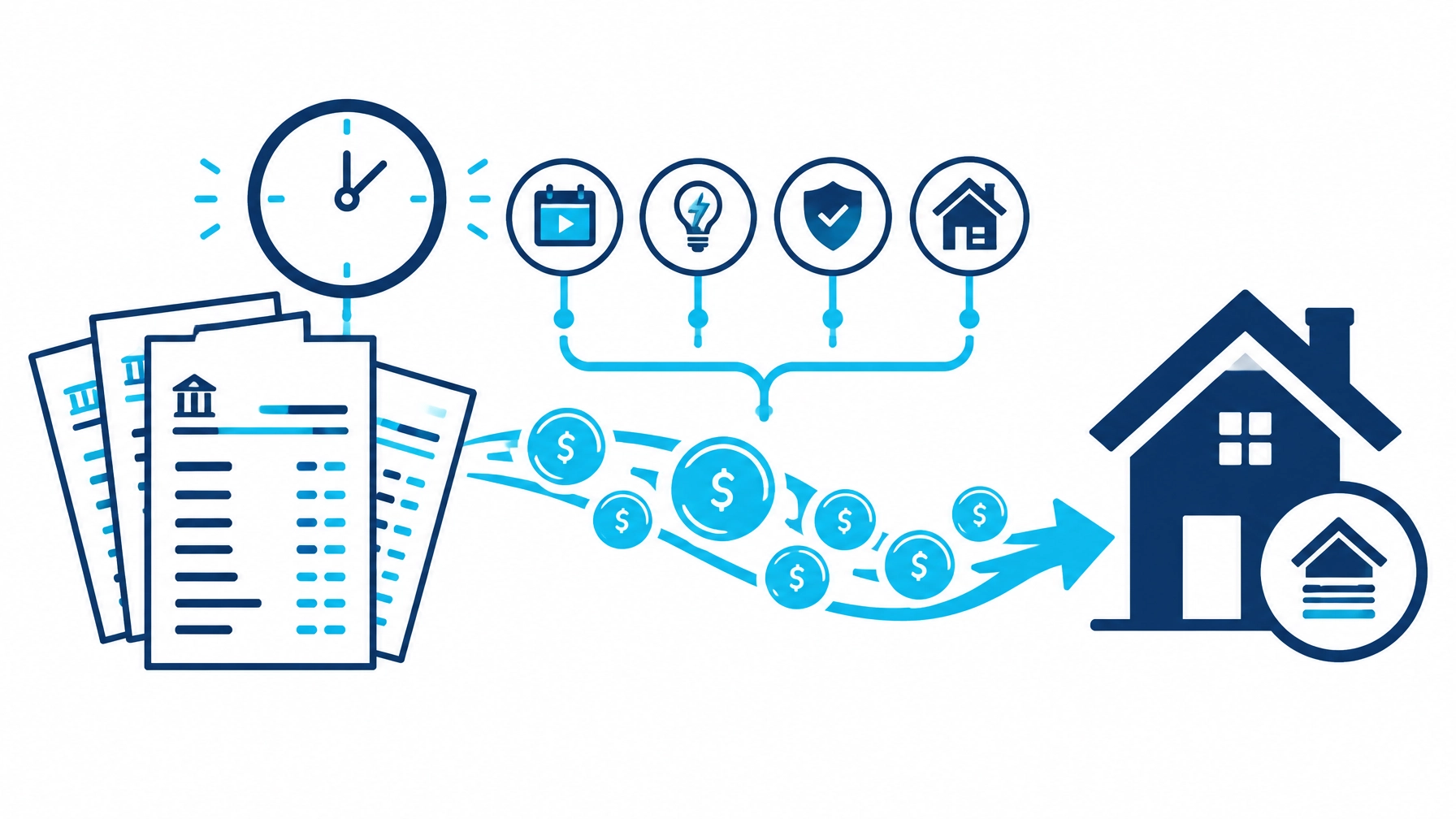
A mortgage can feel like a fixed cost: the repayment leaves your account, and the balance comes down over time. But your existing household spending may also include subscriptions you rarely use, old fees, duplicate cover or a home-loan package that no longer suits your needs.
A focused review can help you find money already moving through your budget, without starting with a demand to cut everything you enjoy. The aim is to identify which costs still deliver value, then decide whether any genuine savings could go toward your mortgage.
This is a one-off audit, not a new payday routine. Set aside about 90 minutes, gather a few recent statements and review your regular expenses and home loan in the same sitting.
Before you start: gather the right information
Collect what you can access easily:
- Recent bank and credit-card statements
- Your latest home-loan statement or online loan details
- Recent electricity, gas, phone and internet bills
- Insurance renewal notices and policy summaries
- A list of subscriptions and memberships
- Any information about personal loans, credit cards or buy-now-pay-later balances
You do not need to build a perfect spreadsheet. A simple note or table is enough. For each item, record the provider, cost, billing frequency, any renewal date and what you plan to check.
For a broader view of your income and spending, Moneysmart’s Budget Planner can help organise regular and irregular costs. Use the correct billing frequency when entering expenses: a quarterly bill and a monthly bill should not be treated as if they arrive at the same interval.
Your 90-minute audit, at a glance
Set a timer if it helps keep the task manageable:
- 10 minutes: Open statements and gather records.
- 20 minutes: Scan for subscriptions, duplicate charges and fee creep.
- 15 minutes: Review utilities and insurance.
- 25 minutes: Check the mortgage’s rate, fees and features.
- 10 minutes: Add up potential savings and choose what to investigate next.
- 10 minutes: Write down follow-up actions and set reminders.
The goal is not to cancel everything or make decisions under pressure. It is to leave with a shortlist of costs worth checking and a clear next step for each one.

Minutes 1–30: spot recurring charges and fee creep
Start with bank and card transactions. Search for repeating payments, including charges that appear monthly, quarterly or annually. A small recurring expense can be easy to overlook, particularly when it is bundled into a larger card statement.
Look for:
- Streaming, music, app and cloud-storage subscriptions
- Gym memberships, clubs and professional services
- Phone or internet add-ons you may no longer use
- Duplicate subscriptions across household members
- Bank account, card or payment fees
- Delivery memberships and recurring donations
- Consumer-debt repayments, interest and account charges
For each charge, ask: Do we still use this? Is it duplicated? Does the current plan still fit? If you do not recognise a transaction, check with the provider or your bank before treating it as a saving.
A service that is still useful may have a cheaper tier or a better plan. If you cancel a service or change cards, make sure other essential recurring payments are updated too. Moneysmart’s guidance on direct debits explains how to manage payments taken from an account.
Minutes 31–45: compare bills and insurance carefully
Check energy and communications plans
For electricity and gas, compare the full bill, not only a headline discount. Check usage rates, daily supply charges, payment conditions and any fees that apply. Your bill may also indicate whether your provider has a better offer available.
Households in eligible states and territories can compare plans through the Australian Government’s Energy Made Easy. Victoria has its own independent comparison service, Victorian Energy Compare.
You can use the same review for mobile and internet plans: compare what you actually use with your plan’s inclusions, excess charges and contract conditions.
Review insurance for cover as well as cost
List each policy’s premium, excess, important limits and renewal date. Check whether two policies appear to cover the same risk, but do not assume they are interchangeable: terms and exclusions can differ.
Before changing or cancelling insurance:
- Confirm what is covered and what is excluded.
- Check that any replacement policy is active before the old one ends.
- Consider whether a higher excess would be affordable if you needed to claim.
- Review whether the insured amount still reflects your circumstances.
The cheapest premium is not necessarily the best value if it leaves an important gap. Moneysmart’s home insurance guidance can help you understand what to compare.
Minutes 46–70: audit the home loan itself
Household expenses are only part of the picture. Your mortgage may have a rate, package fee or feature that deserves a fresh look, especially if your circumstances have changed since you took it out.
Record the details you can find:
- Current interest rate and repayment amount
- Loan balance and remaining term
- Annual package or account fees
- Any offset-account fee or rate difference
- Redraw conditions and possible fees
- Limits or charges on additional repayments
- Fixed-rate restrictions, if applicable
A lower advertised rate does not automatically mean a cheaper loan overall. Compare the rate alongside fees, features, loan conditions and how you actually use the account. If you are considering a change, ask the lender what it would cost and whether any limits apply before acting.
Check whether an offset account is earning its keep
An offset account is a transaction account linked to a mortgage. Its balance can reduce the amount of the loan on which interest is calculated, subject to the loan’s terms. However, an offset feature may come with fees or a different interest rate, so it is worth checking whether the benefit fits your typical balance and account use.
For an accessible explanation, see Moneysmart’s guide to mortgage offset accounts. If your loan has redraw instead, check the lender’s rules: access, timing and fees can differ from an offset account.

Include interest on consumer debt in the same review
If your statements show credit-card or other consumer-debt interest, note the balance, rate and fees. Paying down that debt may be a more suitable priority than adding the same money to your mortgage, depending on the loan terms, interest costs and your circumstances.
This is not a reason to stop required repayments or use home equity without careful consideration. Compare the costs and risks, and seek guidance if you are unsure which debt to prioritise.
Minutes 71–90: turn your findings into a simple action list
For each item you flagged, write down:
| Item | What to verify | Next action |
|---|---|---|
| Subscription | Is it used, duplicated or still good value? | Check plan or cancellation terms |
| Utility bill | Is there a better plan for your usage? | Compare total costs and conditions |
| Insurance | Does the cover still suit your needs? | Review policy details before changing |
| Mortgage | What are the rate, fees and feature rules? | Ask the lender for a current summary |
| Consumer debt | What interest and charges are being paid? | Compare repayment priorities |
Separate confirmed savings from possible savings. A plan that looks cheaper at first glance may have a higher fee or less suitable cover. Also avoid counting the same money twice, for example, a monthly subscription saving should not be listed again as a separate annual saving unless you have converted it to the same time period.
Once you have verified a real reduction in spending, decide what to do with it. Depending on your loan features and access needs, you may choose to place it in an eligible offset account or make an additional repayment. Check your lender’s rules first, and keep enough accessible money for expected bills and emergencies. Moneysmart’s guide to paying off your mortgage faster outlines options to explore.

The point is to redirect spending, not remove every pleasure
A useful audit does not require you to strip your budget back to essentials. It helps you see whether money is going toward services, cover and loan features that still suit your household, and gives you a chance to redirect verified savings toward a goal that matters to you.
The next step might be as small as cancelling one unused subscription or asking your lender to explain a fee. Even when the review does not reveal an obvious saving, understanding your loan’s costs and conditions can help you make more informed decisions.
Flexible Mortgages helps homeowners explore mortgage structures and homeownership strategies through a no-obligation Smart Home Loan discovery discussion. The approach may help some borrowers shorten a 25-year mortgage by up to 17 years, but any outcome depends on individual circumstances, loan terms and financial capacity. A calm review of the money already in your budget can be a practical first step toward greater equity, financial security and long-term success.