
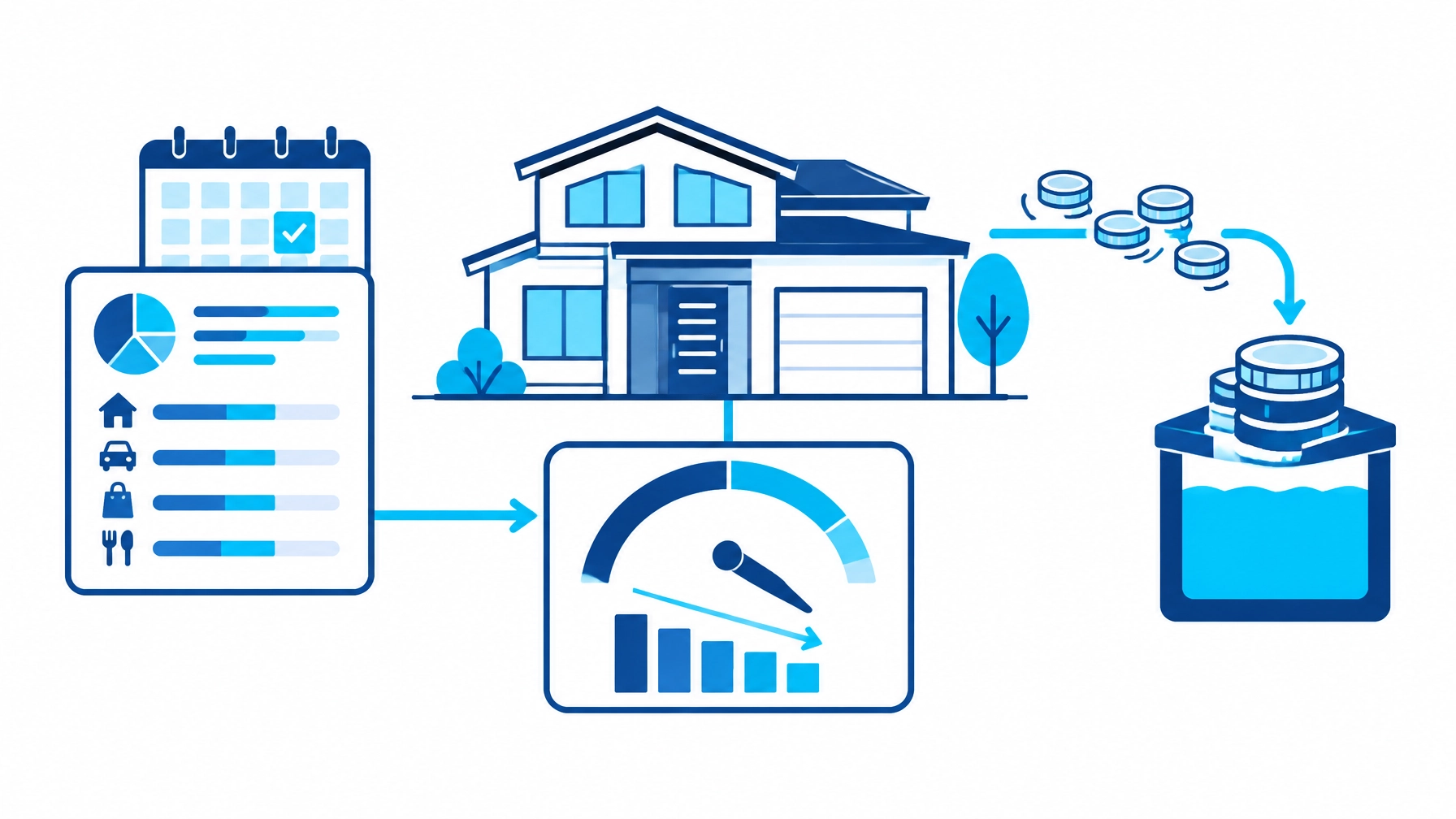
Many household budgets show where money goes. Far fewer are designed to reduce mortgage interest.
In 2026, that distinction matters. The Reserve Bank of Australia’s cash-rate target was 4.60% from 30 September 2026, while average owner-occupier mortgage rates remained around 6%. With cost-of-living pressure continuing, Australian homeowners need a system that is realistic, repeatable and connected directly to their home loan.
This guide explains a practical budgeting system that links your household cash flow with an offset account, automatic payday transfers and a manageable emergency buffer. These budgeting tips for Australia are not about removing every enjoyable expense. They are about giving every dollar a clear job.
Why a normal budget may not reduce your mortgage
A traditional budget often follows this pattern:
- Income arrives.
- Bills are paid.
- Everyday spending occurs.
- Whatever remains is transferred to savings or the mortgage.
The problem is that “whatever remains” is often nothing. Irregular expenses, annual bills and small recurring purchases gradually absorb the surplus.
A mortgage-cutting budget reverses the process. It directs money towards essential bills, financial safety and your mortgage strategy first, then gives you a defined amount for flexible spending.
Furthermore, the budget should work with your loan structure. An offset account, for example, can help reduce the balance on which interest is calculated while keeping your cash accessible.
Step 1: Map your complete household cash flow
Start with your actual take-home income, not your gross salary. Include regular wages, business income, government payments and other reliable sources.
Then list every expense over a full year. Looking only at monthly transactions can hide costs such as annual insurance, council rates, school expenses, car servicing and registration.
The Australian Securities and Investments Commission’s Moneysmart Budget Planner can help organise expenses paid weekly, fortnightly, monthly, quarterly or annually.
Convert irregular costs into monthly amounts
For each annual bill, divide the expected cost by 12. For example:
- $2,400 annual insurance and registration costs = $200 per month
- $1,200 in expected home maintenance = $100 per month
- $1,560 in quarterly council and utility costs = $130 per month
These are not surprises. They are predictable expenses that need a place in the budget.
Step 2: Separate fixed, semi-fixed and variable costs
Classifying expenses makes it easier to identify what can be changed and what must be protected.
Fixed costs
Fixed costs are generally stable or contractually committed, such as:
- Scheduled mortgage repayments
- Rent, if you own an investment property
- Insurance premiums
- Council rates
- School or childcare commitments
- Phone and internet contracts
- Regular subscription commitments
Some fixed costs can still change when a contract renews or interest rates move. Review them periodically rather than assuming they are permanent.
Semi-fixed costs
These vary, but are necessary household expenses:
- Groceries
- Electricity and gas
- Fuel and transport
- Medical costs
- Home maintenance
- Clothing and school requirements
Use recent statements to calculate a realistic average. Underestimating these costs can make a budget appear successful for a month before it breaks down.
Flexible costs
These are expenses where you have more immediate choice:
- Takeaway and restaurants
- Entertainment
- Hobbies
- Clothing upgrades
- Impulse purchases
- Holidays and weekend spending
The objective is not to eliminate flexible spending. Instead, set a limit that supports your lifestyle without quietly reducing your mortgage progress.

Step 3: Use the payday split and buffer method
A budget becomes easier to follow when transfers occur automatically on payday.
Use a central transaction or offset account as the household “hub”. On each payday, split the income into separate purposes.
A practical structure may include:
- Mortgage allocation: The scheduled repayment, or a holding amount if repayments are made on a different date.
- Bills account: Monthly amounts for rates, insurance, utilities, school costs and annual expenses.
- Offset or emergency reserve: A regular contribution towards financial safety.
- Spending account: A weekly amount for groceries, fuel and discretionary purchases.
The buffer method means keeping a modest amount in the hub account for timing differences, price increases and small unexpected costs. Without a buffer, one higher-than-usual electricity bill can force you to use a credit card or withdraw money earmarked for the mortgage.
Your spending allowance should be calculated from what remains after essential transfers, not chosen first. If the available amount is $1,000 per fortnight, divide it into weekly limits rather than allowing the full amount to disappear early in the pay cycle.
Automation is one of the most effective interest-saving mortgage tips because it removes the need to make the same financial decision every payday.
Step 4: Make your offset account part of the budget
An offset account is a transaction account linked to an eligible home loan. The lender generally calculates interest daily on the loan balance minus the money held in the offset.
For example, if you have:
- A $600,000 mortgage
- A 6% interest rate
- $50,000 held in the offset
The lender may calculate interest as though the balance were approximately $550,000. At 6%, $50,000 in the offset represents an initial interest effect of roughly:
| Offset balance | Approximate annual interest effect at 6% |
|---|---|
| $1,000 | $60 |
| $10,000 | $600 |
| $50,000 | $3,000 |
These are illustrations, not guarantees. Actual savings depend on daily balances, loan terms, fees and interest-rate movements. The benefit also falls if the offset balance is regularly withdrawn.
An offset can be particularly useful for:
- Emergency savings
- Upcoming annual bills
- Tax provisions for business owners
- Planned renovations
- Money waiting to be allocated to a future expense
However, compare the account’s fees, package costs and interest rate with the expected benefit. A higher-rate loan with an offset is not automatically better than a lower-cost loan without one.
Read Moneysmart’s guidance on mortgage offset accounts before deciding whether the structure suits your circumstances.
Step 5: Track the true cost of everyday spending
Small expenses can have a large annual effect when repeated.
Review the previous three months of statements and group spending into categories such as:
- Streaming and software subscriptions
- Food delivery and takeaway
- Coffee and convenience purchases
- Grocery top-ups
- Energy usage
- Online shopping
- Banking and package fees
A $15 weekly purchase costs approximately $780 over a year. Three unused subscriptions at $18 per month cost $648 annually. Redirecting those amounts into an offset will not transform a mortgage overnight, but it creates a consistent contribution that compounds over time.
For groceries and energy, focus on systems rather than willpower:
- Plan a small number of repeatable meals.
- Compare supermarket prices for regular items.
- Set a weekly grocery ceiling.
- Review electricity plans when contracts expire.
- Use appliances and heating or cooling more deliberately.
- Separate genuine needs from convenience spending.
The key is to make the lower-cost option easier to repeat.

Step 6: Build an emergency fund without stopping mortgage progress
Putting every spare dollar into the mortgage can leave your household financially exposed. A broken appliance, temporary income interruption or urgent medical expense may then require expensive consumer debt.
Moneysmart suggests building enough emergency savings to cover around three months of expenses. You can read its guidance on building an emergency fund.
For many homeowners, a suitable offset can perform both roles:
- It provides accessible emergency cash.
- It reduces daily mortgage interest while the money remains there.
Consider using a staged approach:
- Save an initial cash buffer for immediate emergencies.
- Build towards three months of essential expenses.
- Pay down high-interest consumer debt.
- Continue sustainable extra mortgage contributions.
- Direct bonuses, tax refunds and spending underspends into the offset when appropriate.
Do not reduce your emergency reserve simply to make a larger extra repayment. Financial resilience is part of a successful mortgage strategy.
What extra repayments can achieve
Consider an illustrative $600,000 principal-and-interest loan at 6% over 30 years. The scheduled repayment is approximately $3,597 per month.
The first month’s interest is roughly $3,000, meaning only about $597 of the first scheduled repayment reduces the principal. This is why extra repayments and offset balances can have a meaningful long-term effect.
Under a constant-rate model:
- An extra $200 per month may reduce the loan term to roughly 25 years and save approximately $85,000 in interest.
- An extra $500 per month may reduce the term to roughly 20 years and eight months and save approximately $135,000 in interest.
- Holding $50,000 in an offset may initially reduce interest by about $3,000 per year while preserving access to the cash.
These figures exclude fees and assume the rate remains unchanged. Your lender’s calculator will provide a more precise estimate.
Check your loan conditions before making additional payments. Fixed-rate loans may have repayment limits, and redraw facilities can have different access rules from offset accounts. Moneysmart also provides guidance on paying off your mortgage faster.
Step 7: Complete a 20-minute monthly review
A budget only works if it changes when your household changes. Set a recurring calendar reminder and review:
- Actual income compared with expected income
- Mortgage interest rate and repayment
- Offset balance
- Bills due in the next 60 days
- Grocery, energy and transport spending
- Subscription and recurring charges
- Emergency-fund progress
- Extra repayments made
- Upcoming school, medical or home-maintenance costs
Then make three decisions:
- What should be cancelled or renegotiated?
- What amount can be safely transferred to the offset?
- Does the current home loan structure still suit the household?

A working budget and a smart home loan work together
A disciplined budget is powerful, but it cannot compensate for an unsuitable loan structure, unnecessary fees or an overlooked repayment feature.
A broker can review whether your current loan, interest rate, offset arrangement and repayment options are still appropriate. Standard lenders may not always identify the broader cost-saving opportunities available through different loan structures and homeownership strategies.
At Flexible Mortgages, our approach is based on finding a Smart Home Loan that fits your household’s cash flow and long-term goals. With the right strategy and consistent execution, some homeowners may be able to shorten a standard 25-year mortgage dramatically, potentially by up to 17 years, although outcomes depend on income, loan terms, rates and individual circumstances.
If you would like to understand your options, you can request a no-obligation Smart Home Loan discovery discussion. It is an opportunity to review your situation, ask questions and identify practical next steps without pressure.
A mortgage-cutting budget does not need to be restrictive or complicated. When your income is mapped, your expenses are separated, your payday transfers are automated and your offset is used deliberately, everyday financial decisions can begin working towards greater security, equity and long-term financial freedom.