
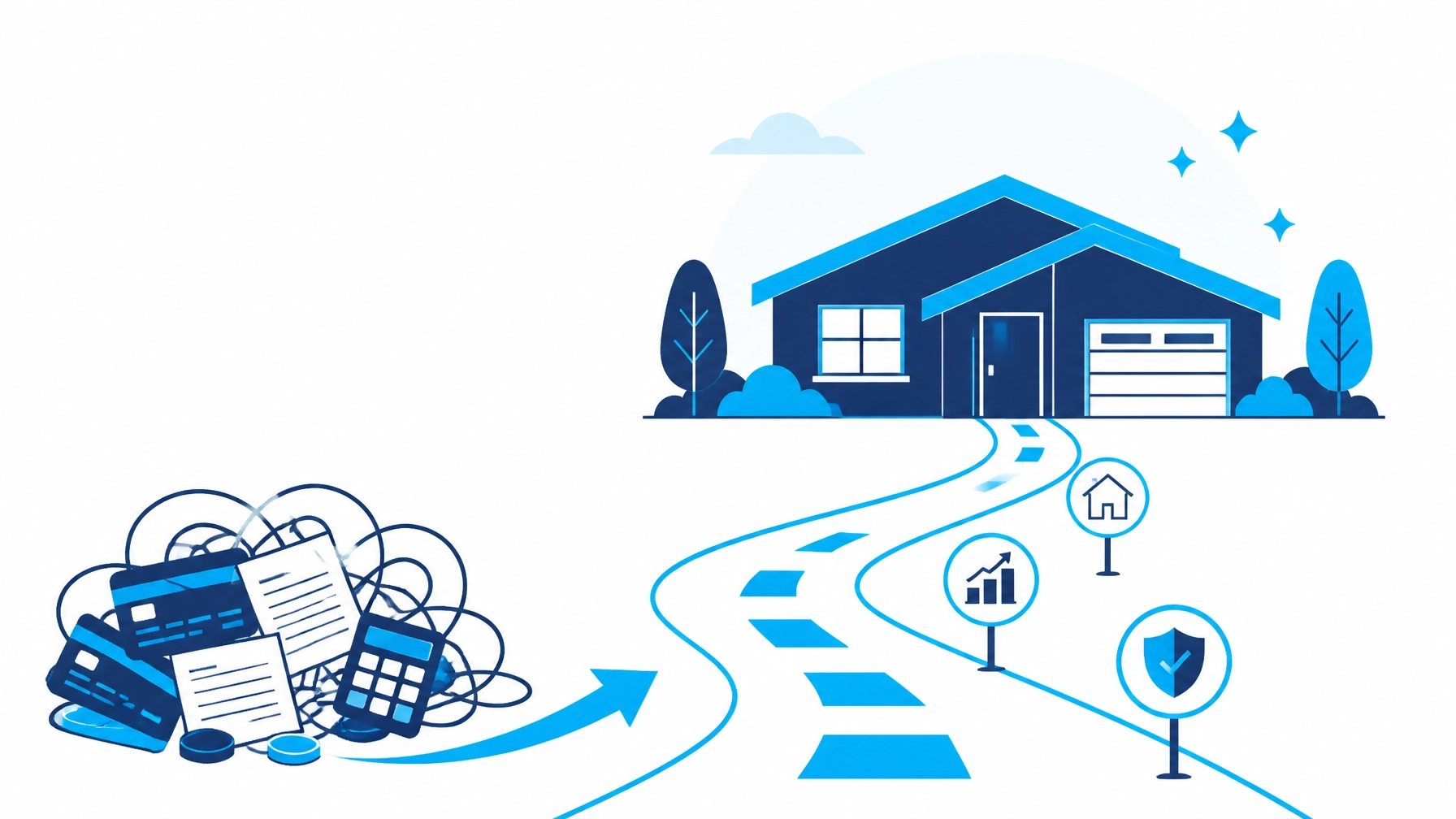
High-interest personal debt can quietly delay your plans to own your home outright. Credit cards and personal loans often carry higher interest rates than home loans, which means a significant part of each repayment may be servicing interest rather than reducing what you owe.
For Australian homeowners, debt consolidation may create a clearer path forward. However, combining debts is not automatically cheaper or faster. The key is to choose the right structure, compare the total cost, and maintain a repayment strategy that eliminates the debt rather than simply moving it elsewhere.
Why personal debt can hold back your home loan goals
A standard credit card interest rate can be substantially higher than a typical home loan rate. Personal loans may also include establishment fees, monthly charges and fixed repayment terms that limit your flexibility.
When you have several debts, your cash flow may be divided between:
- Credit card minimum repayments
- Personal loan repayments
- Store or buy-now-pay-later accounts
- Your regular home loan repayment
- Annual fees and other account charges
This can make it difficult to direct surplus cash towards your mortgage. As a result, your home loan balance may reduce more slowly, even when your household income is stable.
Reducing personal debt in Australia is therefore not only about becoming debt-free. It can also support broader mortgage reduction strategies, helping you build equity faster and potentially pay off your home loan early.
What is debt consolidation?
Debt consolidation means combining multiple debts into one new loan or credit facility. Instead of making several repayments to different providers, you make one scheduled repayment.
Common options include:
- A balance transfer credit card
- A debt consolidation personal loan
- Mortgage refinancing or a home loan restructure using available equity
Each option has different benefits, costs and risks. Your best choice will depend on the debt amount, interest rates, repayment capacity, credit history and available home equity.

Option 1: Use a balance transfer carefully
A balance transfer credit card allows you to move eligible credit card debt to a new card, often with a promotional low or 0% interest rate for a limited period.
This may suit you if:
- Your credit card balance is relatively small
- You have a reliable monthly surplus
- You can repay the balance before the promotional period ends
- You are disciplined about not using the old cards again
Before applying, check:
- The balance transfer fee
- The annual or monthly card fee
- The promotional period
- The interest rate that applies after the offer ends
- The minimum repayment rules
- Whether new purchases attract a different interest rate
A balance transfer is only effective if the balance is cleared within the offer period. Paying only the minimum repayment may leave you with a large balance when the higher revert rate begins.
A practical approach is to divide the transferred balance by the number of interest-free months. For example, if you transfer $6,000 over 12 months, your repayment target would need to be at least $500 per month, plus any applicable fees.
Option 2: Consolidate with a personal loan
A debt consolidation personal loan combines credit cards and other unsecured debts into one fixed-term loan. “Unsecured” means the debt is not directly secured against an asset such as your home.
This option may provide:
- One regular repayment
- A defined end date
- A fixed interest rate in some cases
- More certainty than revolving credit card debt
- The ability to stop relying on minimum repayments
You should compare the new loan with your existing debts based on the full cost, not just the advertised interest rate. Include:
- The new interest rate
- Establishment and application fees
- Ongoing account fees
- Early repayment costs on existing loans
- The proposed loan term
- Total repayments over the life of the loan
A lower monthly repayment may simply mean the debt has been spread over a longer period. That can improve short-term cash flow but increase the total interest paid.
Where possible, choose the shortest term you can comfortably afford. Also check whether additional repayments are allowed without penalty. Paying extra can reduce the principal: the amount originally borrowed: and lower the interest charged over time.
Option 3: Use home equity or refinance your mortgage
Some homeowners consolidate personal debt by refinancing their home loan or increasing the loan amount against available equity.
“Equity” is the difference between your property’s current value and the amount you still owe on the mortgage. For example, if your property is worth $800,000 and your home loan balance is $500,000, your gross equity is $300,000.
Mortgage interest rates are generally lower than credit card rates. Therefore, moving high-interest debt into a mortgage may reduce your immediate interest rate and simplify your repayments.
However, this strategy requires particular care.
Credit cards and personal loans are usually designed to be repaid over a relatively short period. A mortgage may run for 20 or 25 years. If you add $20,000 of personal debt to your mortgage and then repay it over the remaining home loan term, you could pay more interest overall despite receiving a lower rate.
You are also changing unsecured debt into debt secured against your home. If you experience financial difficulty, your property may be at greater risk.

How to consolidate without extending the debt unnecessarily
If mortgage consolidation is appropriate for your situation, consider creating a separate repayment target for the debt you are adding.
For example:
- Identify the exact amount being consolidated
- Set a target to clear that portion within three to five years
- Continue making repayments at least equal to your previous combined debt repayments
- Use an offset account or additional repayments to reduce interest
- Avoid drawing the money back out for new discretionary spending
An offset account is a linked transaction account where the balance is taken into account when calculating interest on your home loan. Keeping savings and regular income in an offset may reduce the interest charged, while allowing you to retain access to the funds.
Always compare the full costs of refinancing, including:
- Application and valuation fees
- Discharge fees
- Break costs on fixed-rate loans
- Lender’s Mortgage Insurance, if applicable
- Package or annual fees
- The new loan term
- Any changes to repayment flexibility
The Australian Securities and Investments Commission’s Moneysmart guidance recommends looking beyond the interest rate and comparing fees, charges, affordability and the total cost over time.
Credit card strategies that help prevent the debt returning
Consolidation can fail if the original spending habits remain unchanged. Once your cards are paid off, make it harder to rebuild the balance.
Consider these steps:
- Close unused credit card accounts
- Reduce credit limits that are higher than necessary
- Remove saved card details from shopping websites
- Use a debit card for everyday discretionary spending
- Keep one card only if it serves a clear and controlled purpose
- Set up automatic payments for recurring bills
- Review subscriptions and non-essential expenses
You may also use the debt avalanche method. This means directing additional funds towards the debt with the highest interest rate while maintaining minimum repayments on the others.
If all debts have been consolidated into one account, treat the new repayment as non-negotiable. Any extra income, tax refund or bonus can be directed towards the balance, provided you retain an appropriate emergency buffer.
Personal loan strategies for faster repayment
Personal loans are often easier to manage than credit cards because they generally have a fixed end date. Nevertheless, the term and repayment structure still matter.
To pay a personal loan faster:
- Check whether extra repayments are permitted.
- Confirm whether early repayment fees apply.
- Make repayments fortnightly if the lender allows it.
- Add a small regular amount above the minimum.
- Apply windfalls directly to the principal.
- Avoid refinancing repeatedly unless the total cost improves.
- Do not extend the term simply to reduce the repayment amount.
Fortnightly repayments can sometimes result in the equivalent of an extra monthly repayment each year, depending on how the lender calculates repayments. Confirm the arrangement with your provider rather than assuming every fortnightly schedule works in the same way.
Mortgage reduction strategies after consolidation
Once high-interest personal debt is under control, you can redirect the freed-up cash flow towards your home loan.
Useful mortgage reduction strategies may include:
- Making additional repayments
- Keeping savings in an offset account
- Switching from monthly to fortnightly repayments
- Applying bonuses and tax refunds to the mortgage
- Maintaining repayments when interest rates fall
- Reviewing the loan structure and fees periodically
- Avoiding unnecessary interest-only periods
- Separating short-term spending money from mortgage funds
The objective is not simply to lower your monthly repayment. It is to reduce the principal sooner and keep the mortgage term from expanding.
Flexible Mortgages focuses on alternative home loan structures and ownership strategies designed to help eligible homeowners own their home sooner. Depending on your circumstances, the right structure may help reduce interest costs and support the goal of paying off your home loan early. Results vary, and no mortgage strategy can guarantee a specific outcome.

A practical debt consolidation checklist
Before proceeding, work through the following list:
1. Create a complete debt summary
Record each account’s:
- Current balance
- Interest rate
- Minimum repayment
- Remaining term
- Fees
- Early repayment or discharge costs
2. Calculate your total current cost
Add together your current repayments and estimate the total amount you will repay if the debts remain unchanged.
3. Compare consolidation options
Review a balance transfer, personal loan and mortgage restructure where relevant. Compare the total repayment amount, not only the interest rate.
4. Set a faster repayment deadline
If debt is added to your mortgage, avoid allowing it to run for the full remaining loan term. Establish a separate target and monitor it regularly.
5. Close or reduce old facilities
Make sure existing debts are actually paid out and accounts are closed or reduced. Otherwise, you may accumulate new debt on top of the consolidated balance.
6. Seek support if repayments are difficult
If you are already experiencing financial hardship, applying for another loan may not be suitable. The National Debt Helpline provides free, independent financial counselling on 1800 007 007.
You should also be cautious of unsolicited debt-consolidation offers and check that any credit provider or broker is appropriately licensed. The ASIC professional registers can help you verify licensing details.
The key is choosing the right structure: not simply one repayment
Debt consolidation can simplify your finances and reduce interest costs, but it is not a solution by itself. The result depends on the new loan structure, repayment term, fees and your ability to avoid taking on new debt.
For homeowners, the most effective personal debt reduction strategy may involve coordinating your credit cards, personal loans, mortgage and cash savings rather than considering each account separately.
If you would like to understand how your current debts may affect your home loan goals, you can request a no-obligation Smart Home Loan discovery discussion with Flexible Mortgages. A conversation can help you identify potential options and clarify the next steps without pressure.
With the right information and a disciplined plan, reducing personal debt can become easier than many people expect: and may provide a stronger foundation for financial security, faster homeownership and long-term financial freedom.