
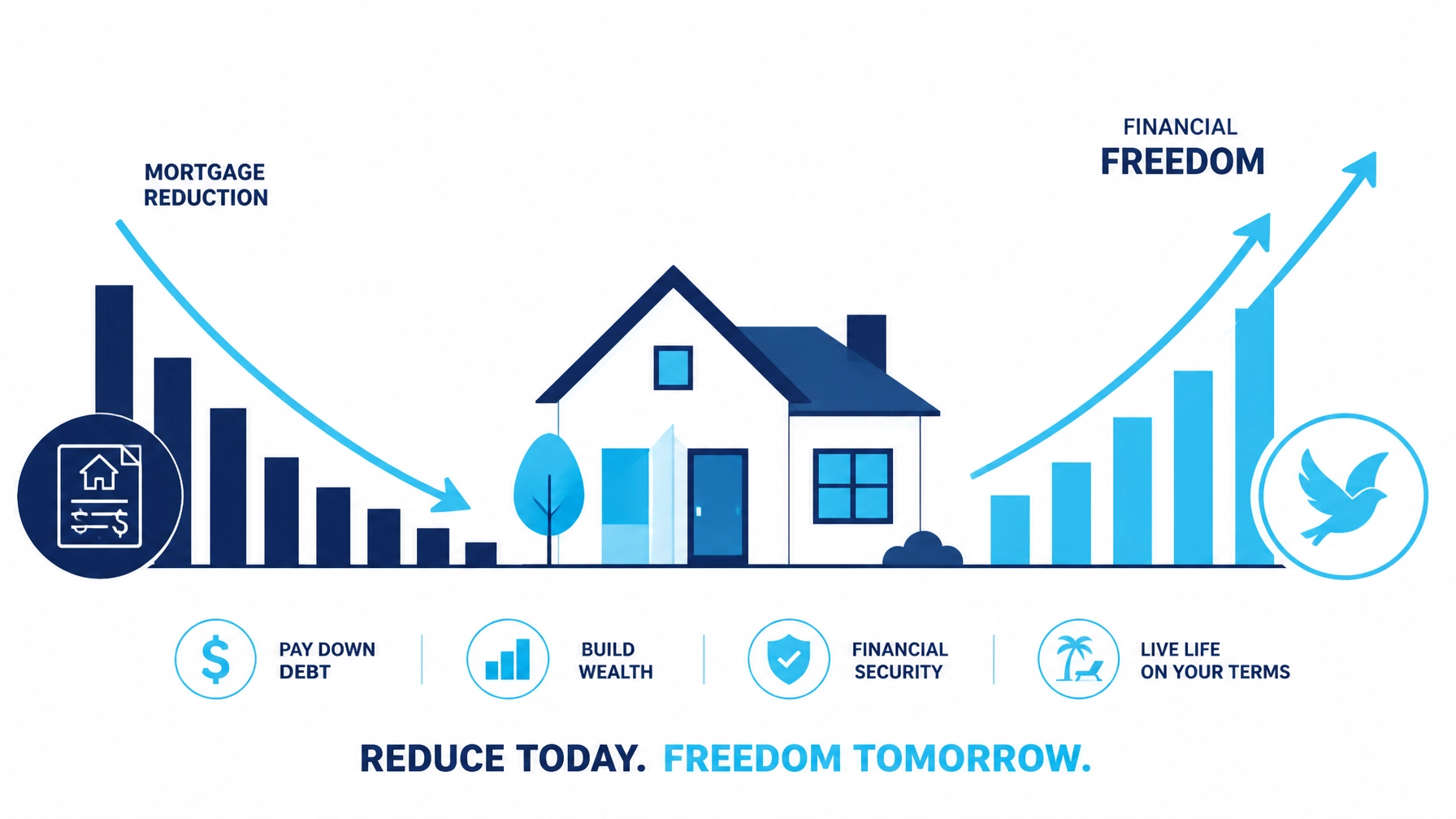
For most Australian homeowners, signing a home loan feels like locking into a 25- or 30-year financial marathon. The standard mortgage structure is designed to keep you paying interest for decades, often resulting in paying two to three times the original value of your home just in interest charges.
However, escaping this long-term debt trap is much easier than many people expect. By implementing proactive financial habits and optimizing your loan structure, you can dramatically reduce mortgage interest and build equity at an accelerated pace.
At Flexible Mortgages, we believe that homeownership should empower your financial future rather than anchor it. In this guide, we will explore the core mechanisms: from offset accounts to disciplined extra repayments: that show you how to pay off mortgage faster and take control of your financial destiny.
1. The True Cost of a Standard Mortgage
When you take out a traditional home loan, your monthly repayments are calculated to amortize the debt over a long period. In the early years of the loan, the vast majority of your payment goes toward interest rather than paying down the principal balance.
As a result, progress can feel painfully slow. Without active management, standard lenders benefit from decades of compounding interest at your expense.

The key to breaking this cycle is understanding that mortgage interest is calculated daily and charged monthly. This mathematical reality is your greatest advantage. Any strategy that lowers your average daily balance will instantly reduce the amount of interest you owe, shortening your loan term without requiring drastic lifestyle sacrifices.
2. Unlocking Mortgage Offset Account Benefits
One of the most powerful tools available to Australian borrowers is the 100% offset account. Understanding mortgage offset account benefits is essential for anyone serious about minimizing lifetime interest costs.
What Is an Offset Account?
An offset account is a everyday transaction or savings account linked directly to your variable home loan. While the money sits in this account, it is not earning traditional savings interest. Instead, its balance is subtracted from your loan principal when the bank calculates your daily interest.
- Example: If your remaining loan balance is $600,000 and you maintain $50,000 in your offset account, you are only charged interest on $550,000.
- Full Liquidity: Unlike locking money away in a fixed term deposit, your funds remain fully accessible for groceries, bills, or emergencies at a moment's notice.
- Tax-Effective Savings: Because every dollar in your offset reduces non-deductible home loan interest, it effectively delivers a tax-free return equal to your mortgage interest rate.
To maximize this feature, consider having your salary paid directly into your offset account. Furthermore, using a reward credit card for everyday expenses: while paying the balance off in full each month: keeps your cash sitting in the offset account longer, compounding your interest savings.
3. Accelerating Progress with Extra Repayments
While offset accounts offer flexibility, making regular extra repayments is another cornerstone of effective home loan payoff strategies.
How Extra Repayments Work
Any amount you pay above your required minimum monthly repayment goes straight toward reducing the loan principal. Because the principal is smaller, subsequent interest calculations shrink permanently.
- The Power of Consistency: Adding just $200 extra per month to a standard loan can shave years off your repayment timeline and save tens of thousands of dollars in interest.
- Redraw Facilities: Most variable-rate loans with extra repayment features also include a redraw facility, allowing you to access those extra funds if an unexpected expense arises.
Offset vs. Extra Repayments: Which Is Right for You?
Mathematically, keeping money in an offset account or paying it directly into a loan via extra repayments yields the exact same interest savings. The difference comes down to psychology and flexibility:
- Choose Offset if you value maximum liquidity and want easy access to your savings.
- Choose Extra Repayments if you prefer a disciplined, "set-and-forget" approach where funds are slightly less tempting to spend on impulse purchases.
4. Practical Step-by-Step Plan to Cut Your Loan Term
Implementing these strategies successfully requires a structured, step-by-step approach. Here is a practical roadmap to help you navigate your home loan optimization:
- Audit Your Current Loan Structure: Review your loan documents to confirm whether you have a 100% offset account and whether extra repayments or redraw facilities incur any hidden fees or restrictions.
- Automate Your Savings: Set up automatic transfers so that surplus funds move into your offset account or loan principal the day you get paid.
- Resist Repayment Reductions: As you get ahead, many lenders will offer to lower your minimum required payment. Always maintain your higher repayment amount to keep momentum going.
- Direct Windfalls Wisely: Allocate tax refunds, work bonuses, or inheritance payments directly into your offset or extra repayments rather than lifestyle inflation.
5. How Flexible Mortgages Can Help You Achieve Financial Freedom
Navigating home loan options and optimizing complex financial structures can feel overwhelming when done alone. Standard lenders rarely point out features that reduce their interest revenue, which is why independent guidance is invaluable.

At Flexible Mortgages, we specialize in proprietary homeownership strategies that can reduce mortgage terms by up to 17 years. Our team excels at identifying cost-saving opportunities and structural inefficiencies that standard lenders often overlook.
Through our tailored Smart Home Loan discovery discussion, we analyze your current financial situation to design a customized roadmap. We help you avoid the pitfalls of high-interest products and structure your finances for maximum efficiency: all in a smooth and stress-free manner.
Conclusion
Owning your home sooner is not about living a life of deprivation; it is about smart financial positioning and making your money work harder for you. By leveraging offset accounts, committing to strategic extra repayments, and reviewing your loan structure, you can reclaim decades of your financial life.
The key to long-term success is taking that first proactive step. If you are ready to explore your options and discover how much time and interest you could save, we invite you to reach out.
Visit our website at Flexible Mortgages to book your no-obligation discovery discussion today, and take a confident stride toward complete financial freedom and security.
