
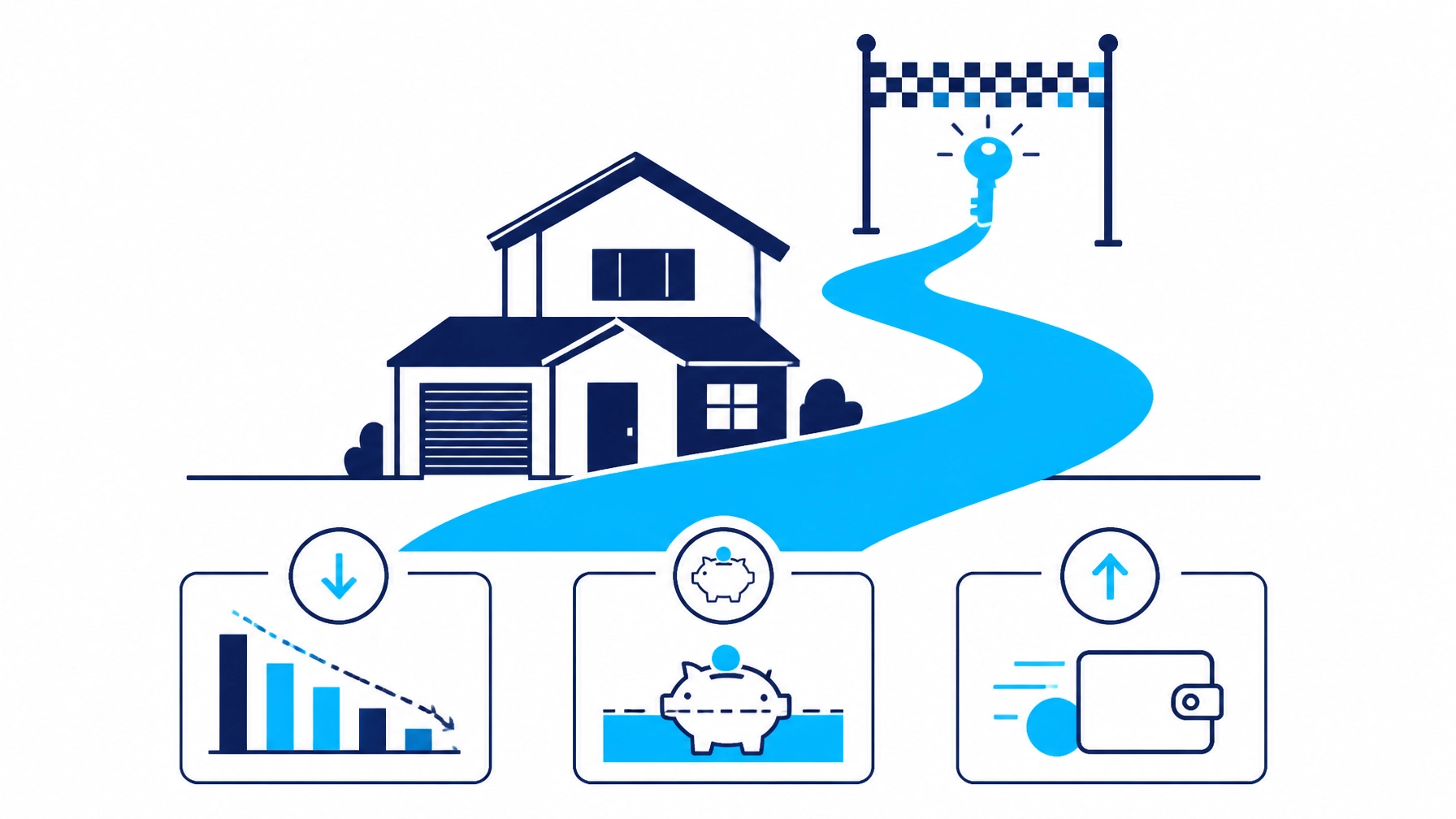
For many Australian homeowners, the goal is not simply to meet the minimum repayment each month. It is to reduce mortgage interest, build equity faster and reach the point of owning the home outright sooner than the standard 25- or 30-year loan term.
The good news is that this can be easier than many people expect. Two of the most practical tools available are a mortgage offset account and extra repayments. Used thoughtfully, they can help you pay less interest, shorten the life of your loan and create greater financial flexibility.
However, the right approach depends on your loan structure, cash flow, discipline and future plans. This guide explains how each strategy works and how to combine them into a sustainable plan.
Why paying the minimum can keep you in debt longer
Home loan repayments generally consist of two parts:
- Interest: the cost charged by the lender for borrowing money.
- Principal: the amount that reduces the original loan balance.
In the early years of a principal-and-interest mortgage, a larger portion of each repayment may go towards interest because the outstanding balance is at its highest. As the principal falls, more of your repayment is directed towards reducing the debt.
This is why small changes made early can have a meaningful long-term effect. If you can consistently reduce the balance on which interest is calculated, more of your regular repayment begins working for you rather than the lender.
The key is not necessarily making one large payment. It is creating a system that keeps surplus money working against the loan over time.
What is a mortgage offset account?
A mortgage offset account is a transaction or savings account linked to an eligible home loan. The balance in the account is offset against your mortgage balance when the lender calculates interest.
For example:
- Home loan balance: $600,000
- Offset account balance: $30,000
- Balance used to calculate interest: approximately $570,000
Most Australian home loans calculate interest daily, although the exact process depends on the lender and product. This means money held in the offset can reduce interest costs for each day it remains there.
You do not usually earn interest on the offset balance. Instead, you receive an interest saving broadly equivalent to your home loan interest rate. This is one of the key mortgage offset account benefits, particularly for homeowners who maintain regular savings or receive their income into the account.
The mortgage offset account benefits worth understanding
An offset account can be useful because it combines debt reduction with access to your cash.
1. It can reduce the interest charged
Every dollar held in a genuine 100% offset can reduce the balance used for interest calculations. As a result, less interest may be added to your loan over time.
The potential benefit becomes greater when you:
- Have a substantial cash reserve
- Deposit your salary into the offset
- Pay household bills from the account
- Keep savings there instead of in a separate low-interest account
- Maintain the balance consistently throughout the month
2. It can help you pay off your mortgage faster
Your scheduled repayment may not automatically change when money is held in an offset account. Instead, less of each repayment is used to cover interest, leaving more to reduce the principal.
Over time, this can help you pay off your home loan sooner: provided you continue making the required repayments and do not continually withdraw the money.
3. It keeps your savings accessible
Unlike money paid directly into the loan, funds in an offset account are generally available through a debit card or online banking. This can make the account suitable for:
- Emergency savings
- Annual bills
- Renovation funds
- Parental leave planning
- Irregular household expenses
- Future property or investment plans
This flexibility is often the main reason homeowners prefer an offset over putting every spare dollar directly into the mortgage.

How extra repayments reduce your loan term
Extra repayments are amounts paid above your required minimum repayment. They reduce the principal directly, meaning future interest is calculated on a lower outstanding balance.
Depending on your lender and loan type, you may be able to make extra repayments:
- Weekly or fortnightly
- As a regular additional amount
- Through a lump-sum payment
- Using a tax refund or work bonus
- After selling an asset
- By rounding repayments up to the nearest $50 or $100
For example, increasing a monthly repayment by even a modest amount can have a larger impact than expected because the additional money reduces the principal earlier. The interest saving then compounds over the remaining life of the loan.
This is one of the most reliable home loan payoff strategies because it is simple to automate. Once the extra amount is built into your repayment schedule, you do not need to make a new decision every month.
Offset account or extra repayments: which is better?
There is no universal answer. Both approaches can reduce the balance on which interest is calculated, but they offer different levels of access and control.
| Feature | Offset account | Extra repayments |
|---|---|---|
| Where the money sits | In a linked transaction account | Directly against the loan |
| Interest benefit | Reduces the balance used to calculate interest | Reduces the loan principal |
| Access to funds | Usually immediate, subject to account terms | May require redraw and lender approval or conditions |
| Best suited to | Homeowners who value flexibility | Homeowners confident they will not need the money |
| Main caution | Fees or a higher interest rate may apply | Redraw restrictions or repayment limits may apply |
An offset may be preferable if you want to build an emergency reserve while still reducing interest. Extra repayments may suit you if you are comfortable committing the money to the loan and want a more structured debt-reduction approach.
Some homeowners use both: surplus cash remains in the offset, while a separate automated amount is paid directly into the mortgage.
A practical framework for paying off your mortgage faster
If you are wondering how to pay off mortgage faster, start with a plan that is ambitious but sustainable.
Step 1: Review your current loan structure
Check:
- Whether your loan has a 100% offset or partial offset
- The offset account’s ongoing fees
- Whether the interest rate is higher because of the offset feature
- Any limits on extra repayments
- Whether redraw is available
- Whether your loan is fixed, variable or split
- What happens if you refinance or repay early
A feature is only valuable if its benefit outweighs its cost. For example, an offset account with a higher annual fee may not be worthwhile if your average balance is consistently low.
Step 2: Establish a cash-flow hub
If your loan includes a suitable offset, consider using it as your main money-management account.
You could arrange for:
- Your salary to be paid into the offset
- Regular bills to be paid from it
- Savings goals to be tracked within the same account
- Automatic transfers to cover discretionary spending
- A minimum emergency reserve to remain untouched
The aim is to keep your average balance as high as reasonably possible without making your day-to-day finances difficult to manage.
Step 3: Automate a manageable extra repayment
Rather than committing to an amount that creates financial pressure, begin with a figure you can maintain through changing circumstances.
Possible approaches include:
- Adding $50 or $100 to each fortnightly repayment
- Rounding a $2,860 monthly repayment up to $3,000
- Directing half of each annual bonus to the loan
- Increasing repayments whenever your income rises
- Making one additional repayment each year
Consistency matters. A smaller amount paid regularly can be more effective than an occasional payment that is difficult to repeat.

How to shorten the loan term without overextending yourself
Shortening the formal loan term can increase your required repayments. That may help you clear the mortgage sooner, but it can also reduce your monthly breathing room.
Before changing the term, consider:
- Whether your income is stable
- How much emergency savings you hold
- Upcoming expenses such as school fees or renovations
- The impact of future interest-rate rises
- Whether your household could cope with reduced income
- Whether your lender allows repayment flexibility
You do not always need to formally change from a 25-year loan to a 15-year loan. Another approach is to keep the existing contractual term but voluntarily pay more whenever your budget allows. This can preserve flexibility while still accelerating your payoff.
Furthermore, if circumstances change, you may be able to reduce your repayments back to the contractual minimum: subject to your loan conditions.
Important Australian loan considerations
Before relying on an offset or extra repayments, read the product terms carefully. Not every loan offers the same features.
Pay particular attention to:
- Fixed-rate limits: Fixed loans may restrict extra repayments or apply break costs if you repay, refinance or sell early.
- Offset type: A 100% offset generally provides a different benefit from a partial offset.
- Account fees: Package fees, monthly account fees and rate premiums can reduce the value of an offset.
- Redraw conditions: Redraw access may be subject to lender rules, processing times or minimum withdrawal amounts.
- Repayment recalculation: Your minimum repayment may not automatically decrease after making extra payments.
- Loan purpose: Tax and ownership considerations can differ between owner-occupied and investment loans.
If you are unsure how the features interact, professional guidance can make the process smoother and less stressful. A broker can help compare loan structures, lender policies and the total cost: not just the headline interest rate.
Flexible Mortgages explains how tailored loan advice can help homeowners identify opportunities to tackle home loan complexity and save interest.
A sustainable strategy is better than an extreme one
Paying off a mortgage faster should not require sacrificing every other financial priority. You may still need to:
- Maintain an emergency fund
- Pay down higher-interest personal debt
- Contribute to superannuation
- Budget for property maintenance
- Protect your income and family
- Save for known future expenses
The most effective strategy is one you can maintain for years. In reality, financial progress often comes from combining several small advantages: a competitive loan, an appropriate offset, automated extra repayments and regular reviews.
Interest rates, income and household priorities can all change. Reviewing your strategy periodically can help ensure your loan continues to support your broader financial goals.
Take the next step towards owning your home sooner
An offset account and extra repayments can be powerful tools, but they need to fit the way you earn, spend and save. The right structure may help you reduce mortgage interest, build equity sooner and avoid remaining tied to a standard loan term longer than necessary.
If you would like to explore your options, Flexible Mortgages offers a no-obligation Smart Home Loan discovery discussion. It is an opportunity to review your current position, discuss your goals and identify potential home loan payoff strategies; without pressure to proceed.
With a clear plan and consistent habits, owning your home sooner can become a practical long-term objective rather than a distant ambition. The result may be greater security, financial freedom and a stronger foundation for your future.
This article provides general information only and does not constitute personal financial advice. Loan features, fees, eligibility requirements and outcomes vary between lenders and individual circumstances. Consider the relevant product terms and obtain professional advice before making a decision.