
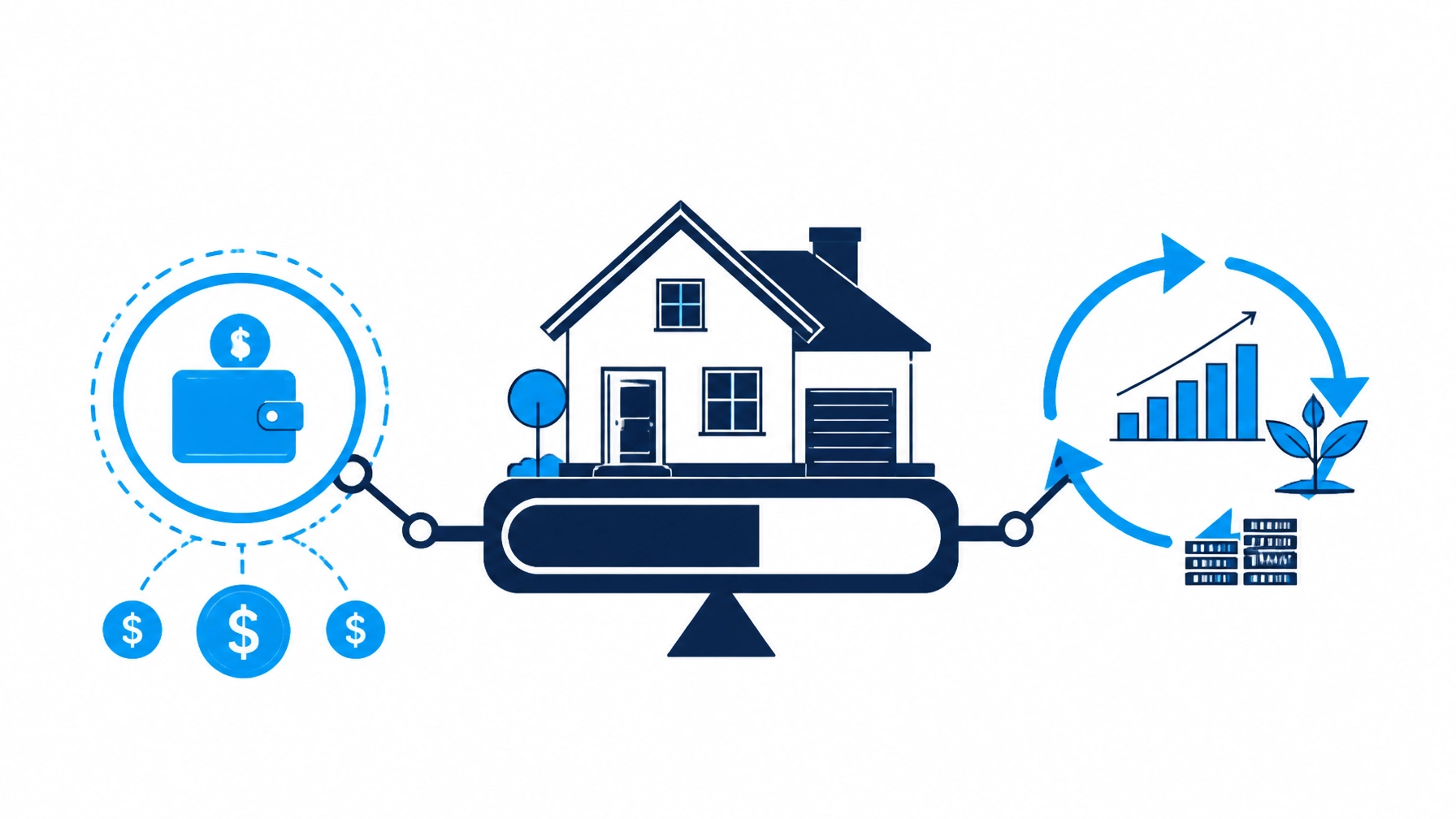
For Australian homeowners, paying extra into a mortgage is one of the most effective ways to reduce mortgage interest and build equity faster. However, deciding what to do with surplus cash is not always straightforward.
Should you keep it in an offset account, where it immediately reduces the interest charged on your home loan? Or should you consider debt recycling, which may help convert some non-deductible home debt into tax-deductible investment debt?
The answer depends on your goals, tax position, investment plans and tolerance for risk. This guide compares both strategies in plain language so you can identify the approach that may suit your circumstances.
Important: This article provides general information only. Tax treatment and lending outcomes depend on your individual situation. Obtain personal advice from a registered tax adviser or licensed financial adviser before implementing debt recycling.
The short answer: offset for certainty, debt recycling for potential after-tax benefits
An offset account generally provides a simple, low-risk interest saving. Every dollar held in the account can reduce the mortgage balance used to calculate interest, while allowing you to access the funds when needed.
Debt recycling is more complex. It involves paying down non-deductible home debt and then borrowing that amount again through a separate loan split to purchase income-producing investments. The investment loan interest may be tax-deductible, provided the borrowing is used for an eligible income-producing purpose and the arrangement is properly documented.
In summary:
- An offset account usually wins for simplicity, flexibility and certainty.
- Debt recycling may produce greater long-term after-tax benefits if you intend to invest anyway.
- Neither strategy eliminates investment risk or guarantees a particular result.
What is an offset account?
An offset account is a transaction account linked to your home loan. The balance is offset against your mortgage principal when your lender calculates interest.
For example:
- Home loan balance: $600,000
- Offset account balance: $100,000
- Interest calculated on: $500,000
As a result, the $100,000 in the offset reduces the interest charged without requiring you to permanently pay the money into the loan.
Key mortgage offset account benefits
An offset account may be useful because it:
- Reduces interest on your owner-occupied home loan.
- Provides a tax-free interest saving.
- Keeps your cash accessible for emergencies or planned expenses.
- Can simplify household cash flow if your salary and bills are managed through the account.
- May help you pay off your mortgage faster without making a formal investment decision.
The interest saving is effectively linked to your home loan rate. If your mortgage rate is 6%, holding $50,000 in offset for a full year could save approximately $3,000 in interest before considering daily balance movements and lender calculations.
That saving is generally not taxable because it is interest you did not pay, rather than income you received.

What is debt recycling in Australia?
Debt recycling is a home loan payoff strategy that aims to change the purpose of part of your borrowing.
The basic process is:
- You use available cash to pay down your home loan.
- You redraw or borrow the same amount through a separate loan split.
- You use the borrowed funds to purchase income-producing assets.
- The interest on that investment borrowing may become deductible, subject to Australian tax rules.
The crucial principle is loan purpose. The Australian Taxation Office generally considers how borrowed money is used, rather than simply the name of the loan or account.
For example, interest may be deductible where borrowed funds are used to purchase investments that are expected to produce assessable income, such as:
- Dividend-paying shares or exchange-traded funds.
- An investment property.
- Certain managed investments.
By contrast, interest on borrowing used for your private residence or personal expenses is generally not deductible.
You can read the ATO’s guidance on interest, dividend and other investment income deductions.
A simple debt recycling example
Assume you have:
- A $500,000 owner-occupied mortgage.
- $50,000 of surplus cash available.
- A home loan interest rate of 6%.
- A plan to invest for the long term.
Option one: keep the money in the offset
The $50,000 remains in your offset account. The lender calculates interest on approximately $450,000 rather than $500,000.
At 6%, the approximate gross interest saving is:
- $50,000 × 6% = $3,000 per year
The saving is relatively predictable, provided the loan rate and offset balance remain unchanged.
Option two: debt recycle the money
You pay the $50,000 into the home loan, reducing your non-deductible debt. You then redraw $50,000 through a separate investment loan split and use it to purchase income-producing investments.
The home loan interest is still reduced because the private loan balance has fallen. However, you now have $50,000 of investment debt and pay interest on that amount.
At 6%, investment-loan interest would be approximately $3,000 per year. If the interest is deductible, the after-tax cost may be lower depending on your marginal tax rate.
For example, at a hypothetical 37% marginal tax rate:
- Gross investment interest: $3,000
- Potential tax effect: approximately $1,110
- Illustrative after-tax interest cost: approximately $1,890
This is only an illustration. The actual outcome depends on your taxable income, deductions, investment income, tax legislation and personal circumstances. It also does not account for investment gains, losses, fees or changes in interest rates.
Which strategy saves more interest?
The answer depends on what you mean by “save”.
If you mean gross interest paid
An offset account may be the clear winner.
Keeping $50,000 in an offset reduces the amount of your mortgage that attracts interest. You do not create a new investment loan and therefore do not incur additional investment-loan interest.
Debt recycling usually means you continue paying interest on the amount borrowed for investing. Although that interest may be deductible, you are still paying it.
If you mean after-tax cost and long-term wealth
Debt recycling may be more effective for a homeowner who:
- Intends to invest regardless.
- Has a stable income and reliable cash flow.
- Has a moderate or high marginal tax rate.
- Understands investment volatility.
- Can maintain the strategy over a long period.
- Is comfortable carrying investment debt.
The potential advantage is that your home loan becomes smaller while some borrowing is redirected toward an income-producing purpose. The interest on that investment portion may be deductible, and the investments may generate income or grow over time.
However, tax deductions do not make an investment profitable. A deduction generally reduces taxable income; it does not reimburse the full interest cost.
When an offset account may be the better choice
An offset may suit you if:
- You want a low-risk and straightforward strategy.
- You may need access to your savings.
- You are building an emergency fund.
- You are uncertain about investing with borrowed money.
- Your marginal tax rate is relatively low.
- You expect to buy another property or need flexibility for a future deposit.
- You prefer a guaranteed interest saving over an investment return that can fluctuate.
An offset is also easier to understand and manage. This can be valuable because a strategy that is simple enough to maintain consistently may outperform a more complicated strategy that is poorly implemented.
When debt recycling may be worth exploring
Debt recycling may be appropriate to investigate if:
- Your household budget produces regular surplus cash.
- You have a long investment timeframe.
- You are comfortable with market falls and investment uncertainty.
- You understand that the investment debt remains payable even if asset values decline.
- You can keep private and investment borrowings separate.
- You are prepared to maintain accurate records.
Correct loan structuring is essential. Mixing private and investment expenses in one loan account can make the tax position difficult to trace and may reduce the clarity of future deductions.
A common approach is to use:
- One loan split for the owner-occupied mortgage.
- Separate splits for each investment borrowing.
- A dedicated offset account for private home debt.
- Clear transaction records showing exactly where each redraw was invested.

Key risks and mistakes to consider
Debt recycling is not a shortcut to guaranteed wealth. Before proceeding, consider the following risks:
Investment losses
Shares and other investments can fall in value. You may still need to repay the loan even if the investment portfolio declines.
Interest-rate changes
If loan rates rise, the cost of investment debt may increase. A tax deduction may soften the impact but will not remove it.
Cash-flow pressure
Investment income may be irregular or lower than expected. You need enough income to meet repayments without relying entirely on dividends, rent or distributions.
Poor loan separation
Using one loan for multiple purposes can create complicated interest calculations and record-keeping problems. Clean loan splits are generally easier to manage.
Overestimating tax benefits
Your tax benefit depends on your taxable income and eligibility for the deduction. Tax rules can also change, so a strategy should not be based solely on receiving a particular refund.
How to choose between the two strategies
Use this practical decision framework:
-
Establish your emergency savings first.
Do not invest borrowed funds if your household lacks an adequate cash buffer. -
Review your loan structure.
Check whether your current lender offers a suitable offset, redraw facility and separate loan splits. -
Calculate your cash-flow capacity.
Model repayments at higher interest rates and allow for unexpected expenses. -
Clarify your investment timeframe.
Debt recycling is generally more suited to long-term investors than people who may need the money soon. -
Compare after-tax scenarios.
Assess the offset interest saving, investment-loan interest, potential deductions, fees and possible investment returns. -
Obtain tax advice.
A tax adviser can assess whether the proposed borrowing purpose is likely to support a deduction. -
Seek strategic lending guidance.
A mortgage broker can help review loan splits, lender policy, borrowing capacity and refinancing options.
Flexible Mortgages provides mortgage consulting and lending services, including home loans, investment loans and refinancing support. If you are considering property as part of a broader plan, our property investment service may also help you assess borrowing capacity and potential property opportunities.

The bottom line
An offset account is usually the safer choice when your priority is reducing mortgage interest with certainty while keeping your cash accessible.
Debt recycling may be more tax-effective for an experienced, long-term investor who intends to invest anyway and is comfortable with leverage, market risk and additional administration.
The key is not to choose the strategy that sounds most sophisticated. The right approach is the one that fits your cash flow, risk tolerance, tax position and long-term objectives.
A Smart Home Loan discovery discussion can help you review your current structure and compare practical home loan payoff strategies. It is an opportunity to understand your options clearly and without pressure, so you can move towards lower interest costs, greater equity and long-term financial security.